
By Rick Phelps, Principal, Synchronous Solutions
AI is the talk of the town, and everyone is getting into the game.
FOMO rules the business world as this powerful tool rapidly gets more
powerful.
Should you be using AI in your fabricating
business?
Absolutely!*
*The old rule of “Garbage In, Garbage Out” is now on steroids.
From Skeptic to Power User
My wife Sharon was an early adopter of AI and ChatGPT in her real
estate business. I was not. I guess you could say I was an AI skeptic,
and in some ways, still am.
Then a few months ago, a client, struggling to understand my
instructions on scheduling, put her notes into ChatGPT, gave it some
background, and sent me its 10-page write-up, asking if this was what I
meant?
I think my initial visceral response was panic. It was that good.
Some of that is decades of Theory of Constraints and lean writing
already sitting in the public domain, soaked up by every model out
there. But a brilliant synthesis of good information isn’t the same as
knowing what matters most in your shop, this quarter — a distinction
that took me the next three weeks to fully learn.
That night I bought ChatGPT. A week later, after a meeting with Cody
from Kaplan Consulting as we worked on our StoneSync Pro collaboration,
I also bought Claude, who is now my best work buddy. Sorry Mark, but it
is true.
Three weeks, a thousand dollars, and very little sleep later, I had
finished the five-book Fabricator’s Guide series that describes the core
deliverables of Synchronous Flow — a series I had started writing three
years ago. At the same time, Claude and I wrote the role training
playbooks for all 45 roles in a fabricating shop that operates on
Synchronous Flow, each an approximately 30-page detailed description of
how that role fits into the grand scheme of the business. Then we made
three versions of the playbooks: one for CNC-constrained shops, one for
Cut-constrained shops, and the last for shops running the Hybrid T-Rex.
And then we generated one-page checklists for each role as a companion
guide. I will stop here lest you think I boast, but damn, that’s some
productivity!
Here is what I learned pumping out hundreds of pages of content with
AI’s support. It’s still a huge amount of work. It didn’t take Claude
long to devour all my past writing, our website, and the key TOC
websites, etc., and it didn’t take long for it to write like me and
sound like me. It’s kind of creepy…
Claude freed me from being the writer and allowed me to instead focus
on being the editor. Every page of every document was scrutinized by me,
forcing multiple rewrites.
“You used this term incorrectly — this is what it means and this
is how we use it.”“You are right, I have used that term incorrectly” (with AI you
are always right, until you tell it to cut it out and be critical),
followed by “let me find all the places in the five Fabricator’s Guides
where I used that term incorrectly.” Find and Replace on
steroids!
The first 45 role playbooks were a bear; the following 90 were pretty
much proofreading, with Claude doing minor edits.
I was downright giddy from the massive output and/or lack of
sleep!
Claude enabled me to do these projects that had been on my to-do list
for years in just weeks, but there were important lessons in my initial
AI push.
Augmented Intelligence—or Augmented Ignorance?
As Ford and others have recently learned — Ford rehired roughly 350
veteran quality engineers (grey-beards, they called them) in 2026 after
AI-assisted inspection cameras missed defects that experienced staff
would have caught, a move that helped the company top the J.D. Power
2026 Initial Quality Study — to use AI you need to understand what you
are asking for and know generally what you are expecting.
Claude’s first outputs looked great on the Fabricator’s Guides, but
the devil was in the details. They were not great, and they were not
technically correct either, in many places. And it wasn’t garbage that I
fed Claude, thank you very much.
Artificial Intelligence LLMs are not ‘intelligent.’ They are great
gatherers and organizers of information, and with knowledgeable
guidance, they can help you become extremely productive. As a grey-beard
myself, I like the thought that AI stands for ‘Augmented Intelligence’
instead of ‘Artificial.’
In the wrong hands, AI can also stand for “Augmented Ignorance.”
Borrowing a cartoon concept I saw on LinkedIn, this cartoon shows a
confident AI confirming the belief that highest margin equals most
profitable.
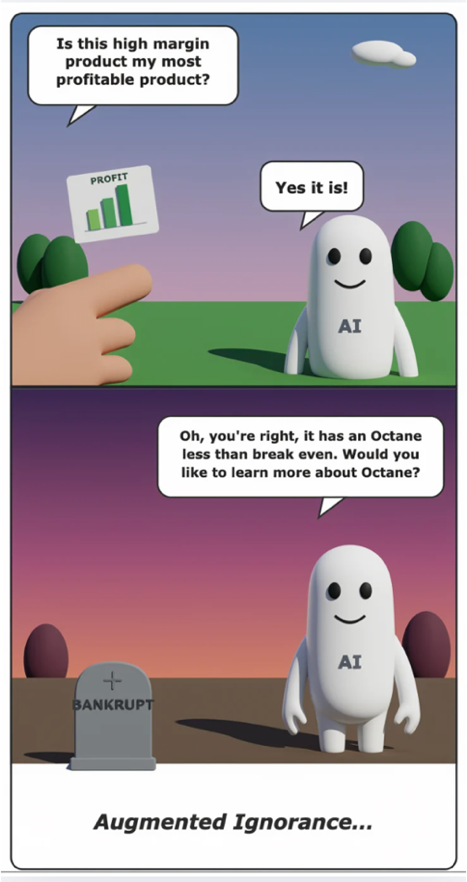
Standard Cost Accounting will hand you that conclusion just as
confidently, because it never asks what the product costs you in
constraint time. Businesses running Synchronous Flow ask that question,
using Octane instead of margin to judge profitability.
Focusing a business on products that got a ‘False High Profitability’
nod from AI could easily cause a company to run itself into cash flow
issues and worse.
Focusing AI on the Right Question
AI is a powerful tool in the right hands and a dangerous one in the
wrong hands. Partly for this reason, we have entered into a strategic
alliance with Thryve.
Thryve is building an AI model that works within the defined
guardrails of a single fabricator, while leveraging industry knowledge
and insights. By working together, Thryve and Synchronous Solutions can
ensure the power of AI is focused on the right questions.
The first body of work in our first collaboration is directly related
to this cartoon. Of the tens of thousands of questions Thryve can
already answer for you, we are focusing this power on answering the
current most important question in fabricating shops: “What is the
estimated Octane of this quote?” Upon Templating of the confirmed order,
that estimate will be refined to calculate Constraint time, used to
control the scheduling and sequencing of work into production.
This focuses the power of AI toward answering the most leveraged
question in any manufacturing company — “at what rate will this job
generate throughput for my business?” — the key question that binds the
front end of the business (Sales, who set the price of the job) to the
back end of the business (Production, whose capacity the job will
consume).
This creates the business hypothesis:
“IF I sell this job at this price, THEN the business will
generate Throughput at a rate that exceeds breakeven by the targeted
amount.”
The single most important hypothesis in the Grand Experiment that is
your business.
AI’s ability to enable you to quickly and cost-effectively answer
this, and all the directly and indirectly related follow-on questions,
will be a massive competitive advantage for the businesses that embrace
it.
But Wait, There’s More
In a recent coaching session with a client, the owner was bemoaning
the fact that their Constraint Machine had broken down, and that in the
process of attempting to repair the machine that morning, further damage
was done, turning the one-day failure into a likely weeklong one. This
particular owner had been experimenting with AI already, so we suggested
he ask ChatGPT a specific question about this particular machine and
this particular failure. In no time at all, a detailed description of
how to repair the machine came out, along with a specific warning about
exactly how they had further damaged the machine, and how to avoid such
a mishap!
But that’s not all that got spit out. It also outlined how to
organize the shop to produce the product without the machine, which they
followed and managed to keep up with the workload the whole time the
machine was down.
Awesome, no?
AI will have a huge impact on shops in the near future — not by
eliminating workers, but by making them far more productive.
IKEA is a great example. Their AI chatbot, Billie, now handles
roughly 47% of routine customer service inquiries — work that could have
eliminated thousands of support jobs and cut their Operating Expense.
Instead, IKEA retrained about 8,500 displaced call center employees into
AI-assisted interior design consultants, creating a major new source of
revenue and Throughput: roughly $1.4 billion in sales last year
alone.
Source: Fortune,
July 2026.
This is a reminder that Throughput is by FAR your biggest lever to
improve Net Profit, followed by reducing Inventory, and in distant last
place, reducing Operating Expense.
AI Agents
Mark’s use of AI is completely different from mine. He has long
conversations with ChatGPT during which he has shared not only the logic
and science that underpin Synchronous Flow, but also his life philosophy
and the ActionCOACH models and concepts central to our business. The
results have been amazing.
Mark records all his sales meetings and then runs those recordings
through his AI agents, using his own insights and all the Synchronous
Flow and ActionCOACH models to critique his performance. Once he got
Chat to quit saying how great he was, it started to give excellent
feedback on exactly where he had deviated from the system or plan. Now
his agents don’t pull any punches. He has created his own sales coach
and other support role agents!
This has also resulted in Mark becoming a brutal critic of my work.
Hearing one such critique, Sharon commented that she was astonished I
could take that from him. It isn’t easy! But when he’s right, he’s
right, dammit!
Done right, AI agents will become an important part of your business
— another reason we are excited to be partnering with Thryve.
Necessary But Not Sufficient
In 2000, Eli Goldratt published the book Necessary But Not
Sufficient. It tackles a problem that has only become more relevant
since its publication:
Why do companies spend millions on ERP systems, CRMs, and other
software yet fail to achieve dramatic business improvements?
Goldratt’s answer is simple:
Technology is necessary — but it is not sufficient.
Software can enable improvement, but it cannot replace good
management. If the management paradigm doesn’t change, technology simply
helps organizations make bad decisions faster.
Here are the parallels between what happened at the turn of the
century with ERP systems and what is happening now with AI:
| Around 2000 | Today |
|---|---|
| ERP | AI |
| “ERP will transform your business.” | “AI will transform your business.” |
| Companies buy software first. | Companies buy AI tools first. |
| Existing processes remain unchanged. | Existing processes remain unchanged. |
| Disappointment follows. | Disappointment is beginning to follow. |
| TOC provides the missing management system. | TOC may again provide the missing management system. |
The technology is different, but the management mistake is the
same.
AI Is an Amplifier
One way to think about AI is this:
AI doesn’t create capability nearly as much as it amplifies
existing capability.
A well-run organization becomes dramatically more effective, while a
poorly run organization becomes dramatically more efficient at producing
confusion.
That’s exactly what happened with ERP. ERP made it easier to manage
large amounts of bad WIP.
AI can make it easier to create large amounts of unnecessary work:
emails, reports, dashboards, analyses, meetings, even software.
The bottleneck hasn’t disappeared.
Synchronous Flow
Becomes Even More Valuable
The more powerful AI becomes, the more valuable SF becomes, because
SF answers the question AI cannot:
“What should we work on?”
AI is extraordinary at helping execute. It doesn’t inherently know
which decision matters most to the system’s goal.
That’s still a management problem.
Tectonic changes are coming to the fabricating industry, and the
shakeup will be brutal for those who are not prepared.
The Fabricator’s Signal will help you separate the signal from the noise as you navigate these changes.
— Rick Phelps
Principal, Synchronous Solutions