
From The Fabricator’s Signal | Issue 1
AI can multiply productivity. It can also multiply the wrong answer.
By Rick Phelps, Principal, Synchronous Solutions
AI is everywhere, and the pressure to use it is hard to ignore. Competitors are experimenting. Vendors are promising transformation. Employees are finding tools on their own. No owner wants to discover too late that everyone else gained an advantage while their business stood still.
The potential benefits are real. AI can reduce administrative work, organize information, support faster decisions, and help people become more productive. Used well, it can contribute to lower costs, more control, reliable delivery, exceptional service, and a stronger competitive position.
But most fabricators are not starting from a perfectly controlled system. They are already dealing with overtime, shifting schedules, callbacks, late jobs, and too many urgent decisions. A tool that produces more work at enormous speed does not automatically create order. It can just as easily accelerate the chaos that is already there.
Should you use AI in your fabricating business?
Absolutely. Just remember that the old rule of Garbage In, Garbage Out is now on steroids.
From Skeptic to Power User
My wife Sharon was an early adopter of AI and ChatGPT in her real estate business. I was not. You could say I was an AI skeptic, and in some ways, I still am.
Then a client who was struggling to understand my scheduling instructions put her notes into ChatGPT, gave it some background, and sent me its ten-page write-up. She asked whether that was what I meant.
My first response was panic. It was that good.
Some of that came from decades of Theory of Constraints and lean writing already in the public domain, absorbed by the models. But a brilliant synthesis of good information is not the same as knowing what matters most in a particular shop right now.
That night I bought ChatGPT. A week later, after a meeting with Cody from Kaplan Consulting about our StoneSync Pro collaboration, I also bought Claude. Claude is now my best work buddy. Sorry, Mark, but it is true.
Over the next three weeks, AI helped me finish the five-book Fabricator’s Guide series that I had started three years earlier. It also helped me create detailed training playbooks for 45 roles in a Synchronous Flow shop, versions for three different constraint configurations, and one-page companion checklists.
That is some productivity.
It was also still a tremendous amount of work. AI freed me from being the first-draft writer and allowed me to focus on being the editor. Every page required knowledgeable scrutiny, technical corrections, and repeated rewrites. Once we fixed the underlying logic, later versions became much easier.
The output increased dramatically. Judgment did not come with it.
When a Confident Answer Is Still Wrong
AI is excellent at gathering information, organizing it, and producing a convincing response. What it does not share is your business objective, your operating context, or responsibility for the result.
That makes knowledgeable guidance essential. In the right hands, AI can become Augmented Intelligence. In the wrong hands, it can become Augmented Ignorance.
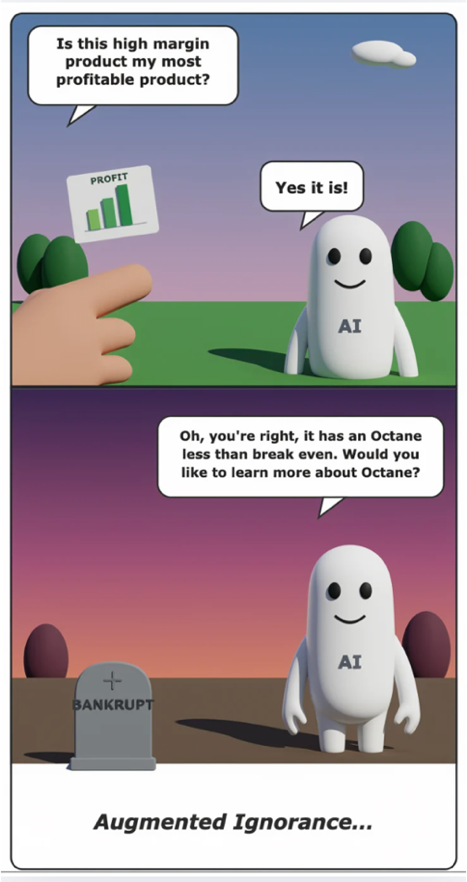
Consider the common belief that the product with the highest margin must be the most profitable. If that is the frame supplied to an AI tool, the answer may confidently reinforce it. Standard Cost Accounting often points in the same direction because it does not ask what the product consumes in constraint time.
A business operating with Synchronous Flow asks a different question: at what rate will this work generate Throughput through the system’s constraint? That is what Octane measures.
The distinction matters. A persuasive answer built on the wrong measure can lead a shop to sell work that overloads its constraint, drives overtime, disrupts delivery, and produces less profit than expected. The AI did not create the faulty assumption. It simply made the assumption faster, clearer, and more convincing.
Technology Is Necessary, Not Sufficient
In 2000, Eli Goldratt published Necessary But Not Sufficient. The book addressed a problem that is even more relevant today: why do companies spend heavily on technology and still fail to achieve dramatic business improvement?
The answer is that software can enable improvement, but it cannot replace good management. If the management model does not change, technology helps the organization execute the same assumptions more efficiently.
The ERP pattern
- ERP was expected to transform the business.
- Companies bought software before changing the management system.
- Existing rules and processes remained largely unchanged.
- Disappointment followed.
The AI pattern
- AI is expected to transform the business.
- Companies buy tools before deciding which business problem matters most.
- Existing measures, priorities, and decision rules remain unchanged.
- The same disappointment is likely to follow.
Technology can enable a better system. It cannot decide what the better system should be.
Start With the Question, Not the Tool
AI can generate answers to thousands of questions. The competitive advantage comes from knowing which two or three questions have the greatest leverage on the business.
That is the management problem Synchronous Solutions helps fabricators solve. Through Synchronous Flow, we help a shop identify its constraint, establish the right measures and priorities, define the operating rules, and build a feedback loop that turns information into better daily decisions.
Once that logic is clear, AI becomes far more useful. Technology partners such as Thryve can help apply AI within shop-specific guardrails, using industry knowledge without losing sight of how that particular business makes money.
One of the first high-leverage questions is whether a prospective job will actually be profitable. That requires more than margin. It requires understanding the constraint time the work will consume and the Throughput it will generate. We examine that decision in Issue 2 of The Fabricator’s Signal.
AI Is an Amplifier
The simplest way to think about AI is as an amplifier.
In a well-managed organization, it can reduce administrative effort, help people learn faster, improve the use of information, and make sound decisions easier to execute. Those gains can support lower costs, greater order and control, more reliable delivery, exceptional service, and a competitive edge in pricing.
In a poorly managed organization, it can produce more reports, more messages, more analyses, and more activity without improving the result. The bottleneck has not disappeared. The important decision has not identified itself. The business can simply become faster at creating confusion.
AI should not set the direction. It should multiply the effectiveness of a sound operating system.
The more powerful AI becomes, the more valuable Synchronous Flow becomes. AI can help execute. Synchronous Flow answers the prior question: what should we work on, and why does it matter to the goal of the business?
That is still a management responsibility. It is also where Synchronous Solutions helps fabricators turn powerful tools into measurable business improvement.
The Fabricator’s Signal helps you separate the signal from the noise and focus on what matters.
Rick Phelps
Principal, Synchronous Solutions