Build the operating foundation
Synchronous Flow Installation
Install the measures, rules, planning disciplines, roles, software, and improvement structure your team needs to schedule throughput and manage flow as an enterprise capability.
Most organizations begin with a diagnostic conversation and a paid Assessment before deciding on the right installation scope.
The purpose of the installation
Move Synchronous Flow from an idea into the way your team runs the business.
The program builds the operating structure required to connect the economic goal to daily work, protect flow across functions, make threats visible, and give the management team a disciplined way to improve the system.
The operating shift
From heroic coordination to shared control.
The goal is not a perfect schedule. It is a team that can see reality, act according to common rules, and keep improving as conditions change.
Before installation
The system lives in people’s heads
- Priorities are negotiated repeatedly
- Readiness is assumed rather than governed
- Capacity and work mix are weakly connected to the financial goal
- Threats surface after options narrow
- The owner remains the default escalation path
After the foundation is built
The team shares an operating logic
- Daily work is scheduled against the T$ target
- Release follows clear readiness and capacity rules
- Job position and delivery risk are visible separately
- Planners have agreed response options
- The SFIT owns a focused improvement agenda
How the installation works
Design with the team, install in the operation, and build the capability to sustain it.
The exact scope follows the Assessment. The operating sequence remains consistent even when the organization, number of sites, or implementation complexity changes.
Align on the diagnosis
Validate the economic opportunity, current constraint, scope, success measures, participation, and implementation priorities.
Build the operating logic
Define the daily T$ calculation, readiness gates, release rules, schedule logic, buffers, roles, measures, and escalation paths.
Put the system into use
Configure visibility, train the team, begin operating cadences, coach real decisions, and stabilize use inside live work.
Strengthen internal ownership
Build the management team’s ability to run the process, facilitate the SFIT, respond to exceptions, and improve standards.
Four months, intentionally compressed.
Momentum matters. When implementation stretches out, teams can disengage, partial practices fade, and work has to be reinstalled. The fourth month protects the transfer rather than leaving adoption to chance.
The operating logic, visibility, roles, measures, and management cadences are put into use while the team receives direct support on real decisions.
Close adoption gaps, strengthen the leaders responsible for the system, and leave enough buffer for information transfer and stable handoff.
What the program installs
A complete operating foundation, not a collection of disconnected tools.
Specific deliverables are adapted to the assessed scope. These are the core capabilities the installation is designed to establish.
Economic target and throughput measures
Translate operating expense, desired net profit, available workdays, and the business goal into a practical daily T$ requirement.
Enterprise flow map and constraint logic
Clarify how demand, readiness, production, install, invoice, and cash connect, and what currently governs total performance.
Readiness and release rules
Define what must be known and true before work enters each engine so incomplete jobs do not destabilize downstream flow.
Capacity-based throughput scheduling
Build the daily mix of work orders around required throughput, available capacity, constraints, promised dates, and readiness.
Buffer zones and work-order risk
Make expected job position visible and distinguish On Track work from Threats and Holes requiring planner attention.
SyFOS visibility and operating use
Support the team with the Synchronous Flow Operating System and the daily management practices that make its signals useful.
Roles, cadence, and decision rights
Clarify who sees, decides, escalates, follows through, and keeps the operating rhythm alive without depending on the owner.
SFIT improvement structure
Create the Synchronous Flow Improvement Team process that converts threats, holes, callbacks, and constraints into better standards.
Who needs to participate
The operating system is built with the people who must run it.
Leadership sponsorship matters, but installation cannot be delegated to a consultant or software administrator. The work crosses sales, project management, production planning, production, installation, finance, and management.
The assessed scope determines the exact team. At minimum, the people who own flow, schedule decisions, readiness, constraint performance, promised dates, and improvement must be involved at the appropriate stages.
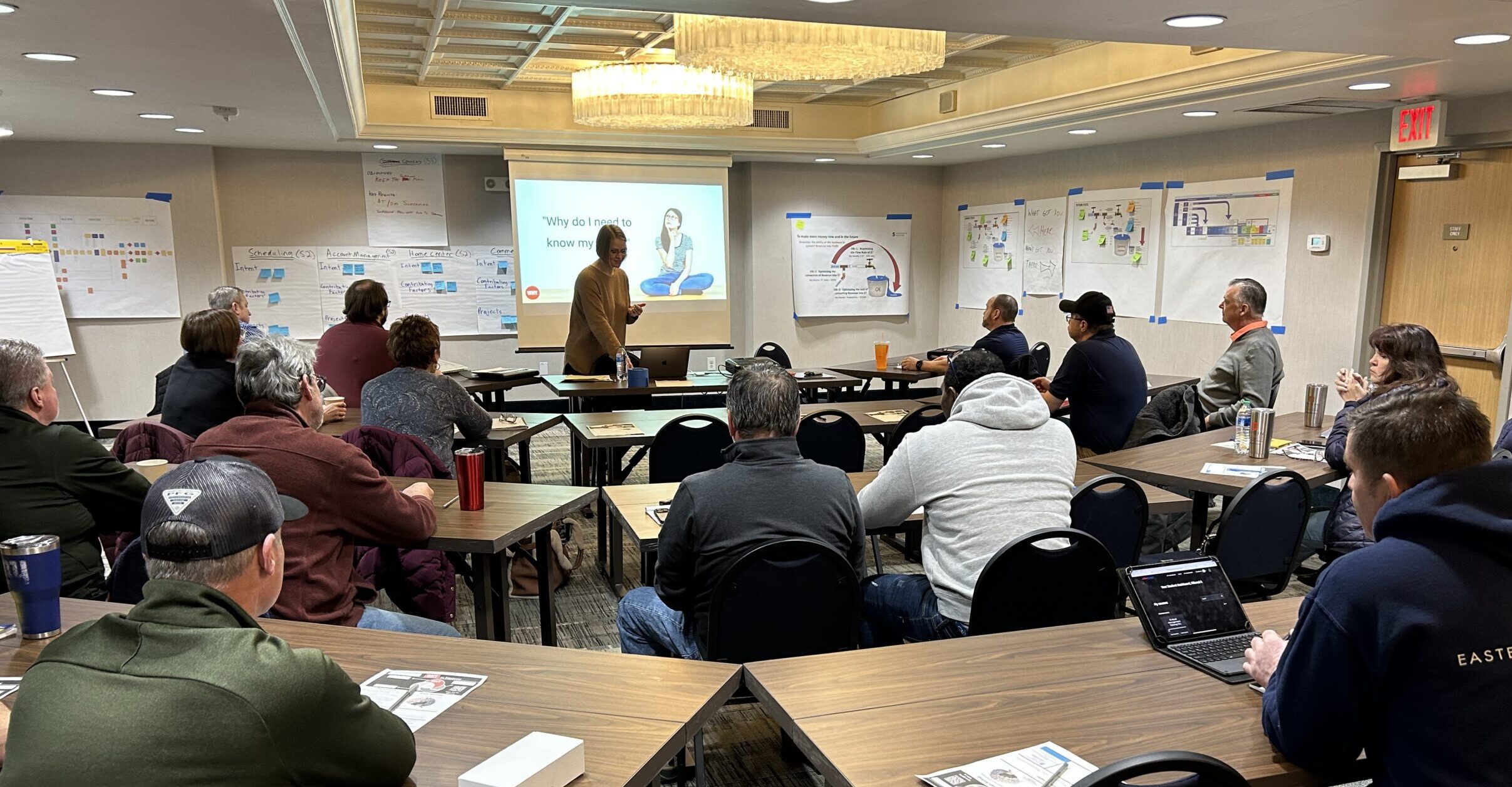 The system is installed with the management team that will own it.
What clients discovered
The most expensive delay can be waiting to feel ready.
“Our business is running better than it ever has. Synchronous Flow manages the complexity and tames the resulting chaos.”Vincent Trento, Owner · Rumford Stone, Inc.
“They helped us realize the profits we knew we could always make. Synchronous Solutions helped us increase our net profit by triple.”Alex Bazdar, CEO · Classic Rock Fabrication
Some clients postponed moving forward because they were unsure the business or team was ready. Once the system was operating, they wished they had not surrendered the additional year to the same recurring problems.
Scope and investment
Enough information to decide whether the conversation is worth having.
These are current standard and recent figures, not a one-size-fits-all quote. Final scope follows the Assessment and reflects organizational complexity, sites, people, travel, and the operating change required.
Enterprise Assessment
$10,000Professional fee for a two-day on-site AssessmentSee the operation and test the economics.
Travel is billed separately. The Assessment identifies what is governing performance, what may be possible, and whether a larger installation is economically responsible.
Direct Installation planning range
$80K–$160KProfessional-fee range used for early planningInstall the operating foundation.
The final scope follows the Assessment and includes the first 12 months of SyFOS. Travel is always treated separately.
SyFOS after year one
$2,400Annual renewal after the included first 12 monthsKeep operating visibility active.
SyFOS supports the daily throughput, release, buffer, and work-order management disciplines installed with Synchronous Flow. Other ongoing support or coaching is scoped separately.
Travel is billed separately. Rockheads member incentives may be available. Ask us about current eligibility and terms. All figures are stated in U.S. dollars and may change as programs evolve.
What kinds of returns have clients reported?
The pattern is broader than one financial measure. Synchronous Flow can create value through profit, capacity, operating expense, capital avoidance, market response, enterprise value, and quality of life.
Material improvement in the financial result.
Clients have reported tripling and quintupling net profit in the first year. In longer-term examples, businesses have attributed roughly $1 million–$1.5 million in added bottom-line performance to the new way of operating.
Overtime reduction alone covered the investment.
One client still inside its four-month Installation recently reported that reduced overtime had already paid for the project before the Installation was complete.
More useful output without immediately buying more capacity.
Clients have opened substantial capacity, shortened lead times, captured market share in time-sensitive segments, and gained flexibility to work around equipment breakdowns.
A stronger business can produce value in several forms.
Reported benefits include sharply lower overtime, maintaining volume through required staffing reductions, delaying or avoiding capital purchases, using existing equipment more effectively, reducing owner dependence, and strengthening a business for a future sale.
These examples were reported across different clients, scopes, and years. They are not a statement of typical results or a guarantee. Formal public case studies and normalized after-the-fact analyses remain an area we are actively developing.
We aim to identify a credible path to 3× the investment in 12 months.
That value may come from increased throughput and sales, reduced or avoided overtime and other operating expense, or capital purchases that can be delayed or avoided because existing capacity is used more effectively.
This is our qualification standard, not a guarantee of results. The Assessment tests whether the path is credible before we recommend proceeding.Choose the right delivery model
Choose the starting point that matches the change you are ready to lead.
You do not need to diagnose yourself or decode every program tier. Use these descriptions to recognize the likely route. A diagnostic conversation confirms the fit before you make a larger decision.
A concentrated installation for a management team ready to change how the whole operation runs.
The strongest fit has capable managers responsible for finance, production, operations, sales, and general management, with an owner or sponsor ready to support the operating change.
- Preferred fit is often above $6 million in annual revenue, although smaller operations can qualify
- Recent direct work spans a roughly $4 million, 30-person shop through fabrication operations producing more than $40 million in annual sales
- Four-month consultant-led installation, including leadership transfer and a protected handoff
A 12-month integrated partnership for broader business and operating-system support.
StoneSync Pro combines Kaplan’s GOS strategic framework with Synchronous Flow, leadership coaching, process standardization, and embedded Bloom and Whale tools.
- Useful when the business wants operating structure, leadership cadence, documented processes, and flow improvement developed together
- Kaplan’s current published tiers range from $4,000 to $20,000 per month across the 12-month program
- The exact Synchronous Flow implementation scope and consultant involvement are confirmed during the fit review
Enterprise program fit
When a direct installation is likely to make sense.
Strong indicators
- Demand exists, but delivery and output remain unpredictable
- Growth is increasing complexity faster than control
- The management team is willing to change operating rules
- Leadership wants economics, flow, and improvement connected
- The organization is prepared to participate in the installation
Reasons to pause
- Leadership wants software without changing management behavior
- The team cannot provide access to the operation or its people
- There is no commitment to use shared measures and rules
- The expected economic benefit cannot justify the work
- A narrower diagnostic or immediate stabilization step is more appropriate
What happens after installation
This is where the real work begins.
The team now has a system to manage. The next chapter is operating it, learning from it, and building the business around it.
SyFOS + Flow Management
Keep daily T$ scheduling, release discipline, buffer signals, planner response, and management follow-through active as conditions change.
SFIT + Ongoing Support
Turn threats, holes, callbacks, and shifting constraints into an evidence-based improvement agenda and stronger standards.
ABOS + Business Coaching
Through our ActionCOACH business, sustain annual, quarterly, weekly, and recurring 8-step planning iterations led by the management team.
Some clients have invested $200,000–$300,000 or more across multiple years as they separately chose ongoing support, additional projects, software, ABOS, or coaching. That is cumulative investment over time, not the price of the initial Installation or a required commitment.
Common questions
What leaders want to know before deciding.
Do we need an Assessment first?
Usually. The standard Enterprise Assessment is a $10,000 professional fee for two days on site, plus travel that is typically $2,000–$4,000. It lets us see the operation, test the economics, understand scope, and determine whether an installation is likely to create sufficient value before either party makes a larger commitment.
How long does an installation take?
Our standard installation window is four months. The first three months concentrate design, installation, training, and live operation. The fourth month reinforces leadership ownership, information transfer, and stable handoff. We intentionally keep the work moving because long gaps create loss of momentum and incomplete adoption.
Is SyFOS included?
Yes. The first 12 months of SyFOS are included with the Synchronous Flow Installation. The annual renewal after that included period is $2,400.
What happens after the installation?
The team begins the ongoing work of managing and improving the system. SyFOS, flow-management support, the SFIT, ABOS, and coaching can sustain the operating and business-building rhythms.
How much does it cost?
The public planning range for a direct Synchronous Flow Installation is $80,000–$160,000 in professional fees. Travel is billed separately, and a typical travel charge is $1,500–$3,500 depending on location and visit duration. Final scope follows the Enterprise Assessment. Rockheads member incentives may be available.
What returns have clients demonstrated?
Reported outcomes across different clients and years include tripling and quintupling net profit, paying for an Installation during the project through overtime reduction, $1 million–$1.5 million in longer-term bottom-line improvement, shorter lead times, added capacity, market-share gains, avoided capital purchases, greater resilience, and improved owner quality of life. These are individual reported examples, not typical or guaranteed results. We aim to identify a credible path to 3× the investment within 12 months before recommending the work.
Can the relationship extend beyond the initial Installation?
Yes. Some multi-year client relationships have accumulated $200,000–$300,000 or more as companies separately chose ongoing support, additional projects, software, ABOS, or coaching. That is cumulative investment over time, not the price of the initial Installation or a required commitment.