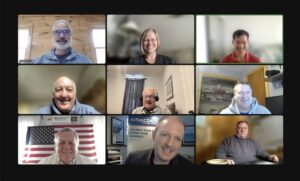
Hallmark Stone reduced callbacks by 70%, improved turnaround times, and built a management team capable of keeping the business running smoothly without constant owner intervention.
Results at a glance
- 70% fewer callbacks
- 96% of jobs installed in fewer than seven days
- 100% of jobs templated in fewer than three days
- Quotes turned around in fewer than two hours
- Stable sales from 2023 to 2024, even as Fred Christen observed many nearby shops and kitchen-and-bath businesses declining by 10% or more
- Greater management ownership and less dependence on the owner for daily decisions
Those results were not produced by pushing everyone to work harder. Hallmark changed how work was planned, released, monitored, and improved.
The challenge: too much chaos and too many last-minute fixes
Hallmark Stone Company celebrated its 25th anniversary in 2023. The business had experience, capable people, and demand for its work. It also had the familiar symptoms of a fabrication operation that was difficult to control: production chaos, inefficiencies, callbacks, and frequent last-minute problem solving.
Owner Fred Christen wanted more than a temporary improvement. He wanted his managers to take ownership, solve problems together, and build a culture of continuous improvement that could continue without depending on him for every answer.
The decision: see a controlled operation in action
Before moving forward, Hallmark visited Front Range Stone, a shop producing a similar volume with Synchronous Flow in place. The contrast was clear. Work moved through the operation with control instead of chaos.
That visit helped the Hallmark team see that a calmer, more reliable operating environment was possible. Fred later said he wished he had brought Synchronous Solutions in sooner.
What changed
Synchronous Solutions helped Hallmark install the management disciplines that make flow visible and actionable. Daily buffer meetings gave the team a shared view of what was on track, what was at risk, and where attention was needed. Weekly guiding-coalition meetings created a cadence for accountability, learning, and improvement.
The team also began managing toward daily, weekly, and monthly Throughput dollar (T$) goals. When a cancellation threatened the schedule, planners could pull from a group of qualified standby jobs instead of simply accepting the lost opportunity.
Cancellations became information. By tracking their causes, the team could respond to recurring issues such as builder scheduling conflicts, site-readiness problems, and other disruptions that had previously been treated as unavoidable surprises.
The measurable results
Hallmark’s operating performance improved across quality, speed, responsiveness, and control:
- Callbacks fell by 70%, reducing waste and supporting stronger profitability.
- 96% of jobs were installed in fewer than seven days.
- Every job in the measured period was templated in fewer than three days.
- Quote turnaround dropped to fewer than two hours.
- Customer calls were answered more promptly after a customer survey exposed the need.
- Sales held steady from 2023 to 2024 while Fred observed many nearby shops and kitchen-and-bath businesses experiencing declines of 10% or more.
The larger result: managers in control
The most important change was not a single metric. Hallmark’s managers began using the system to identify issues, develop solutions, and improve the way the business operated. Fred deliberately stepped back, giving the team room to take ownership.
The business continued to run smoothly when key people were absent. That gave Fred more confidence in the company’s long-term stability and more freedom to think about the future, including retirement.
“It’s really helped eliminate the chaos and just made everybody’s job more enjoyable. When you can focus on just what really needs to be done and you’re on schedule, then you have a lot more time to work on new ideas, new processes, and try new things.”
Fred Christen, Owner, Hallmark Stone Company
A collaborative implementation
Fred described Rob Loughridge’s work with the Hallmark team as collaborative and supportive. The aim was not to impose a stack of consultant answers. It was to help the people closest to the work see the system, make better decisions, and own the improvements they created.
That approach helped build trust and made the new operating disciplines part of how Hallmark managed the business, not a project that disappeared when the consultant left.
Hear the story from Fred
In this interview, Fred explains what changed at Hallmark, what the team accomplished, and what the experience meant to him as an owner.
What another fabricator can learn from Hallmark
- Control begins with visibility. The team needs one shared picture of the schedule and the risks to on-time performance.
- Throughput gives the schedule an economic target. T$ connects today’s production decisions to the financial goal of the business.
- Problems become useful when the team can see and study them. Tracking callbacks, cancellations, threats, and holes reveals where improvement effort will matter most.
- The system must belong to management. Sustainable improvement happens when leaders use the process to make decisions and solve problems themselves.
- Owner independence is an operating result. A business that can perform without constant intervention is more enjoyable to lead and more valuable to own.
Could your operation produce more with less chaos?
A conversation with Synchronous Solutions is a practical place to start. We will learn how your operation works, discuss the problems you are trying to solve, and help determine whether an assessment or another path makes sense.