SyFOS · Synchronous Flow Operating System
SyFOS is how you run your business.
One connected operating system for stone fabrication businesses. SyFOS brings goals, people, work, money, and improvement together, from the owner’s chair to the shop floor and from daily decisions to the annual plan.
Dependable delivery. Stronger cash. Leaders with room to lead.
The essential distinction
One business. One connected way to run it.
SyFOS is the Synchronous Flow Operating System: how you run your business. It connects direction, people, work, money, and improvement, from the first customer conversation to the collected invoice and from daily decisions to the annual plan.
Synchronous Flow provides the principles and eight-step improvement framework behind SyFOS. SyFOS applies that thinking to how the whole business runs. SyFOS software supports the people, decisions, and management routines that keep it working.
The operating system is bigger than the software. The real product is a management team that can see, decide, act, and improve together.Synchronous Flow
The Goal, T$, constraints, buffers, focusing rules, and management disciplines.
Management cadence
Roles, meetings, decision rights, escalation, and follow-through.
SyFOS software
The configurable environment where risk, priorities, commitments, and operating evidence become shared.
SFIT
The Synchronous Flow Improvement Team owns system maintenance, operational learning, and improvement follow-through.
The complete business system
From the first customer conversation to the collected invoice.
SyFOS connects the disciplines a fabrication business needs to deliver for customers, support its people, and build financial strength. Your starting point and implementation scope reflect the capabilities you already have and the conditions that need attention.
Direction
A plan the team can explain.
Agree on what the business is trying to achieve, what must change, and the evidence that will show whether the plan is working.
Production flow
Protect the pace that governs output.
Coordinate readiness, release, and work mix around the resource that sets the pace, so work moves reliably toward the customer promise.
Financial decisions
One picture of how you make money.
Use Throughput economics to connect pricing, job mix, hiring, and capacity decisions to the financial goal.
Cash discipline
Know what is available and what is committed.
Establish routines for supplier commitments, taxes, working cash, and reserves so leadership can plan payments and distributions with a clearer picture.
Leadership structure
Every role knows what it owns.
Clarify responsibilities and decision rights from owner to GM to department managers, so decisions are made at the right level.
Business health
See trouble before it becomes a surprise.
Review Throughput, investment tied up in the business, operating expense, customer experience, people, and the obligations that protect the ability to keep operating.
Management rhythm
Connect today’s work to the annual plan.
Give daily stand-ups, weekly leadership decisions, quarterly priorities, and annual planning a shared direction and clear follow-through.
Continuous improvement
Keep working on what matters next.
Give the Synchronous Flow Improvement Team a standing process to examine causes, test changes, and strengthen the system as the constraint moves.
The management rhythm
A rhythm from daily action to annual direction.
Each meeting has a purpose, each decision has an owner, and follow-through connects the planning horizon to the work.
- 01Annual direction
- 02Quarterly priorities
- 03Weekly leadership
- 04Daily coordination
- 05Improvement follow-through
The supporting digital tools
See how SyFOS software supports daily decisions.
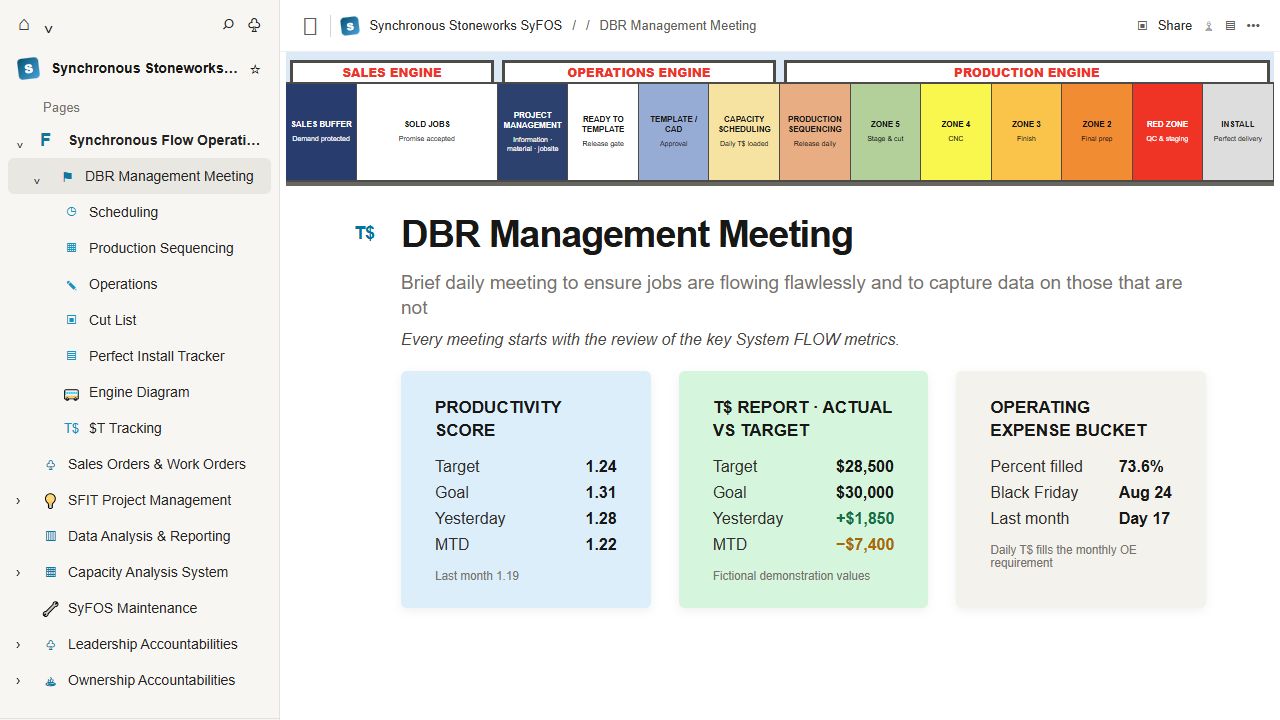
The software supports the wider business system. These representative views show flow-management and improvement tools used in recent fabrication installations. Every company, person, work order, date, and value is fictional.
01 Know the score
Begin with the financial result the system exists to produce.
Daily T$ and the Productivity Score make the economic requirement visible before the team discusses activity. The question becomes, “Did the flow deliver what the goal required?”
Decision enabled: Adjust the mix, capacity, or response before the shortfall becomes a monthly surprise.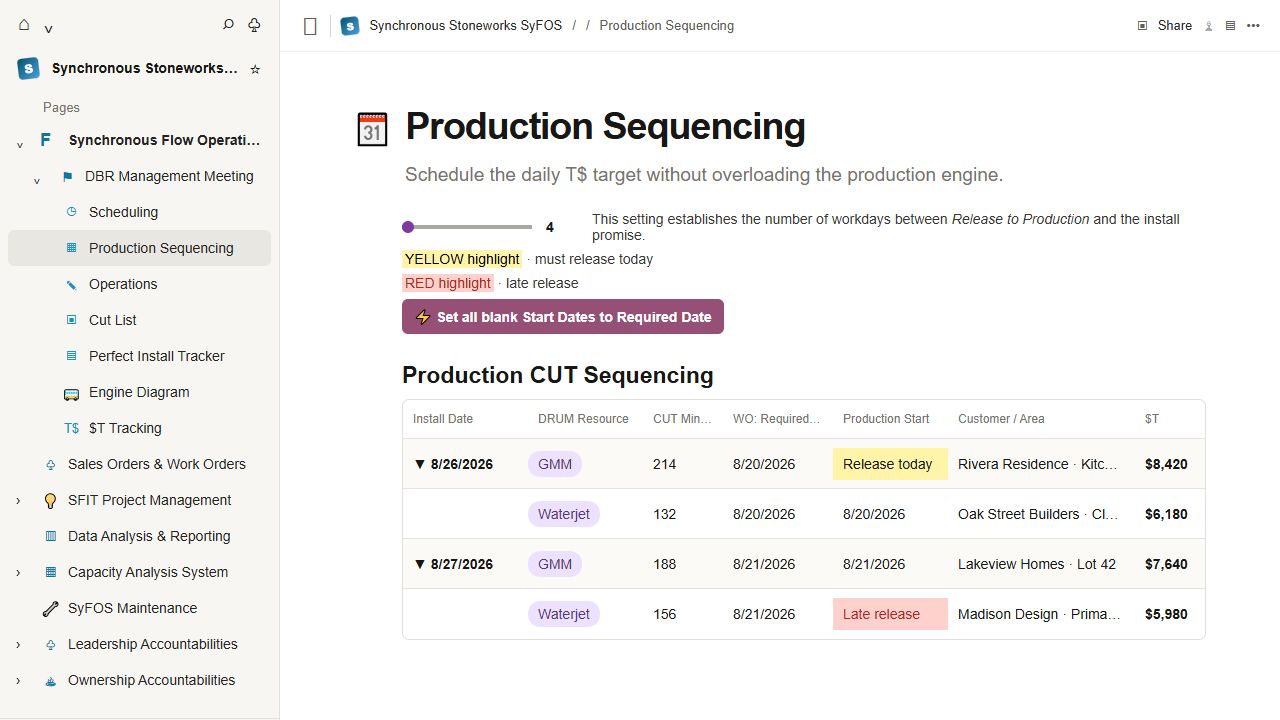
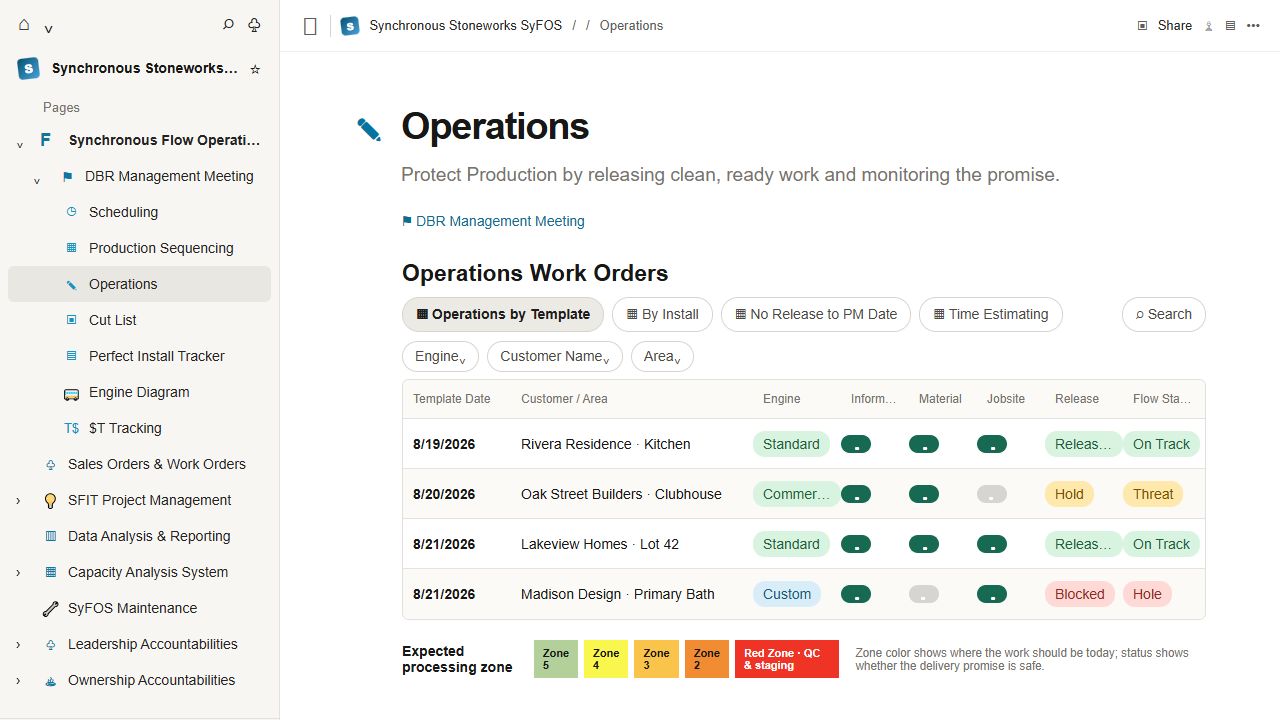
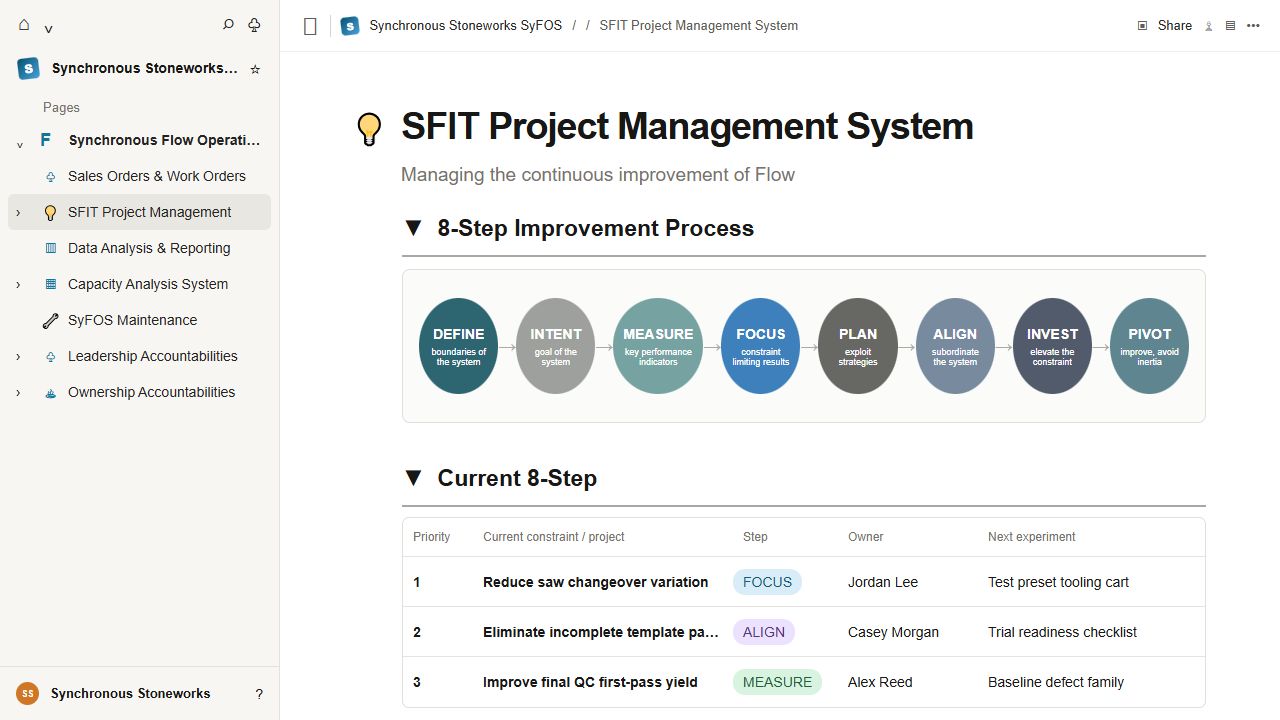
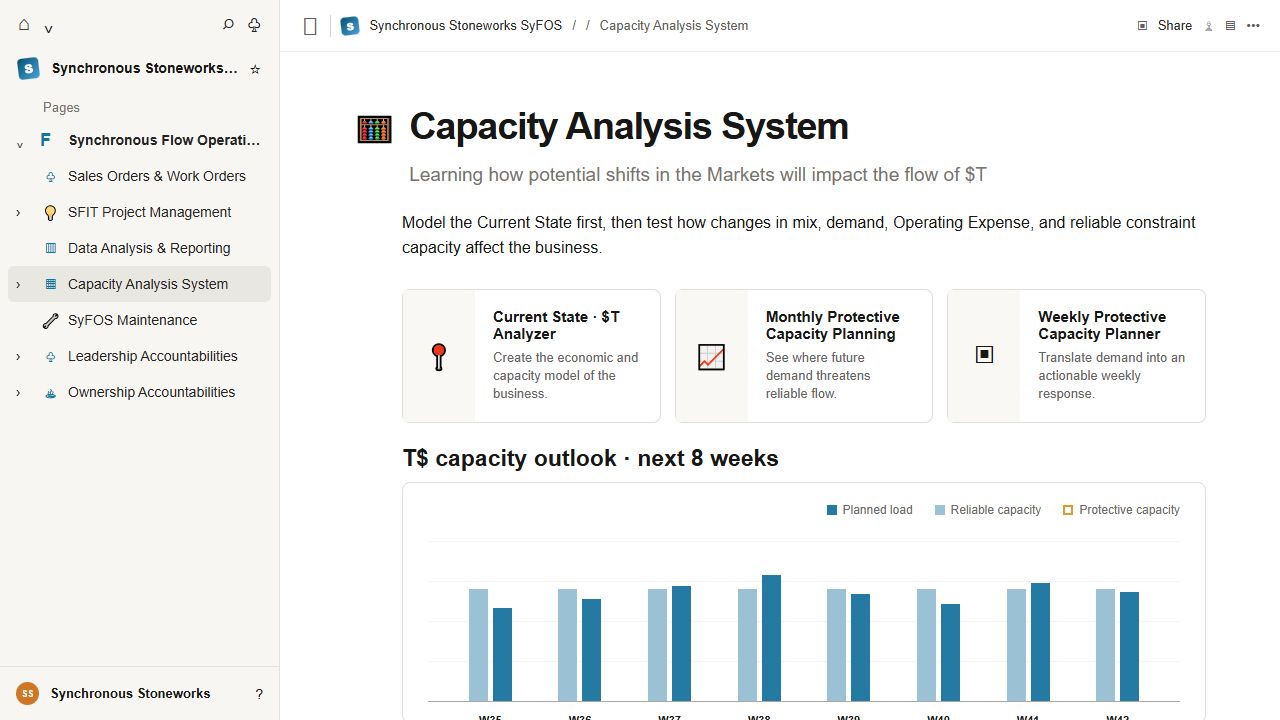
All work orders, people, companies, and financial values shown above are fictional. No client information is displayed.
Your existing tools and practices
Build on what already works.
Your ERP can remain the source of record for customers, orders, and transactions. SyFOS software provides shared operating visibility. If you already use an entrepreneurial operating system, we build on useful leadership meetings, quarterly priorities, values, and issue-solving practices, connecting them to the economics, flow, and cash disciplines of your fabrication business.
The exact data flow is configured to the client’s environment. The goal is useful management visibility, not another disconnected place to maintain information for its own sake.
How it becomes yours
Assess the business. Build the system. Develop your team.
Synchronous Solutions helps you assess the business, establish the operating disciplines, configure useful software, and coach the people who will own the system. The aim is a team that can run and improve it with confidence.
Put the operating tools into use.
Configure the client’s engines, work orders, constraints, readiness rules, T$ measures, roles, meetings, and required views.
Evidence: the team is using SyFOS in live work.Make the work part of management roles.
Clarify who maintains the information, leads each meeting, responds to each signal, owns each decision, and follows through.
Evidence: the system is no longer consultant-dependent.Make Synchronous Flow part of the culture.
Leadership reinforces the goal, managers use the common logic, and the SFIT keeps the organization focused on the next constraint.
Evidence: the business keeps learning as conditions change.Availability and investment
Build the system through a supported engagement.
The Assessment establishes the starting point and scope. A direct Installation builds the operating foundation; coaching, advisory work, and partner programs can develop additional capabilities. Software access and continuing professional support have separate terms.
SyFOS software configuration and operating use are part of the four-month Synchronous Flow Installation. The software supports the transfer from installation into ongoing management.
See Installation scope and investment →The current annual software renewal keeps the configured SyFOS workspace active. Consulting, flow-management support, custom development, training, and other ongoing support are scoped separately.
Talk through ongoing support →Qualifying StoneSync Pro or other supported engagements may include elements of Synchronous Flow and SyFOS. We will identify the sensible route before recommending a larger commitment.
Compare starting points →Common questions
What leaders ask when they first see SyFOS.
How is SyFOS different from Synchronous Flow and the software?
Synchronous Flow provides the principles and eight-step improvement framework behind SyFOS. SyFOS applies that thinking to how the whole business runs. SyFOS software supports the people, decisions, and management routines that keep it working.
Can we keep our existing management system?
Yes. Useful weekly meetings, quarterly priorities, values, and issue-solving practices can be incorporated into one way of running the business. We assess what already works and connect it to the industry-specific flow, financial, cash, and leadership disciplines your team needs.
What is SyFOS?
SyFOS is the Synchronous Flow Operating System: how you run your business. It connects direction, people, work, money, and improvement, from the first customer conversation to the collected invoice and from daily decisions to the annual plan.
Does SyFOS replace our ERP?
No. Your ERP remains the system of record for quoting, orders, customers, and transactions. SyFOS software gives the team shared operating visibility, while the wider system connects goals, responsibilities, management routines, and improvement. The exact exchange of information depends on the client’s current technology and implementation scope.
Is this just scheduling software?
No. Scheduling is one important part. SyFOS also supports daily T$ performance, readiness and release, WIP control, constraint performance, buffer health, work-order risk, install quality, flow disruptions, capacity analysis, role accountability, and SFIT improvement work.
Who uses SyFOS?
Owners, general managers, project managers, production planners, production leaders, finance leaders, and the Synchronous Flow Improvement Team (SFIT) use role-appropriate views. Not everyone needs every screen, but everyone works from the same operating logic and economic goal.
What is the SFIT?
SFIT stands for Synchronous Flow Improvement Team. It is the cross-functional operational-intelligence group that keeps the system maintained, assures useful data is entered and analyzed, manages improvement projects to completion, and sets the capacity roadmap. The SFIT helps the business stay proactive about existing and emerging bottlenecks, preserve protective capacity at non-constraints, and guide utilization and investment at the design constraint.
What does a Synchronous Flow Installation include?
A direct Synchronous Flow Installation builds the SyFOS operating foundation and includes the first 12 months of SyFOS software access. The current annual software renewal after the included period is $2,400. Consulting, coaching, and other ongoing support are scoped separately.
Can we buy the software on its own?
SyFOS software is normally configured and introduced through a Synchronous Flow Installation or another qualifying supported program. Its value comes from pairing the software with the measures, operating rules, roles, and management rhythms that make its signals useful.
Is every SyFOS workspace identical?
No. The core Synchronous Flow logic remains consistent, while engines, constraints, pipelines, readiness rules, roles, views, reporting, and data movement are configured to the operating reality of each client.