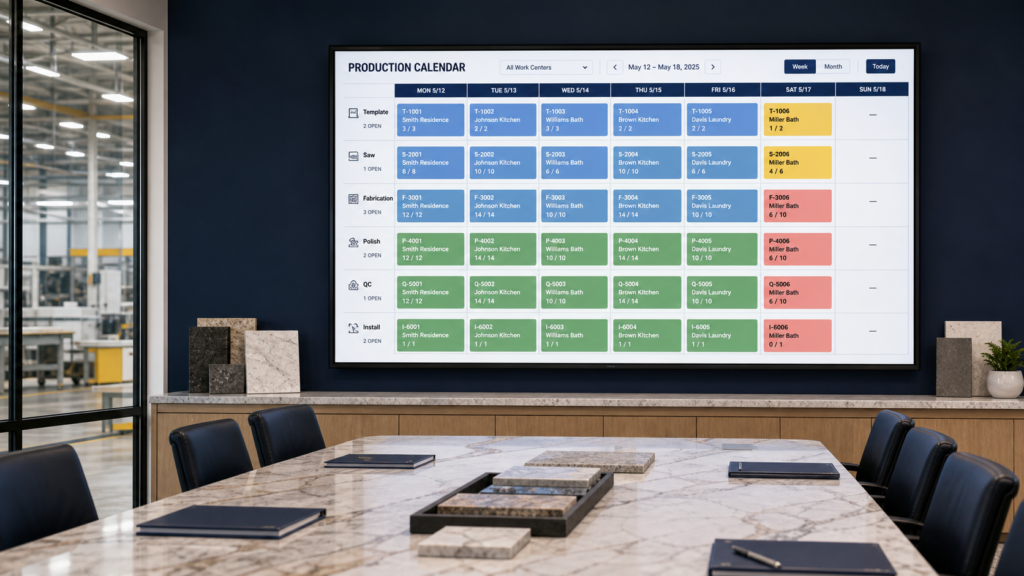
Short answer: Synchronous Flow is an operating system for coordinating the entire countertop fabrication business around its economic goal, available capacity, customer promises, and current constraint. It connects sales, project management, production planning, fabrication, installation, invoicing, and improvement instead of asking each department to optimize its own piece.
Custom countertop fabrication is variable by nature. Every job can bring a different material, edge treatment, sink package, layout, site condition, templating requirement, and installation risk. Demand changes. Information arrives late. Slabs break. Equipment fails. Customers change dates. None of that means the business must accept a constantly changing schedule as normal.
The central management challenge is not eliminating variability. It is building a system that can absorb normal variability while protecting throughput and customer commitments.
Why does a growing fabrication shop become harder to run?
Many successful fabrication businesses begin with an owner and a small team doing whatever it takes to finish the work. That approach can be heroic and effective at a small scale. As volume, people, equipment, product variety, and customer expectations grow, the same approach creates a dependency problem.
The owner or a few experienced managers become the routing system for the company. They decide what should run next, which job deserves attention, whether an exception is truly urgent, and how to recover from yesterday’s disruption. The business grows, but its operating logic remains inside a few people’s heads.
Common symptoms include:
- The production schedule changes several times a day.
- Jobs enter production without complete information, material, approvals, or job-site readiness.
- Everything is described as a priority.
- Overtime becomes the standard recovery method.
- Managers discover late jobs too late to recover them economically.
- Local productivity looks busy while on-time performance and profit remain unstable.
- The owner cannot step away without decisions slowing down or quality slipping.
If that sounds familiar, the issue is usually not a lack of effort. It is a lack of shared operating rules.
What does Synchronous Flow change?
Synchronous Flow treats the business as one connected system. The organization begins with the goal of the whole, identifies the condition currently governing output, and aligns the rest of the business to support that flow.
Five disciplines make that idea operational.
1. Translate the financial goal into a daily throughput target
The business identifies the operating expense it must cover and the net profit it intends to produce. Dividing that requirement across the available workdays creates a daily Throughput dollar target, or T$ target.
(Operating Expense + Desired Net Profit) / Available Workdays = Daily T$ Target
This does not replace the income statement. It turns the financial goal into a daily operating requirement. The production schedule can now be evaluated by the value the system must generate, not only by job count or square feet.
2. Identify what currently governs total output
Every connected system has a condition that governs how much it can produce. It may be a physical resource, a policy, incomplete information, market demand, management attention, or another constraint.
Improving a non-constraint may create more activity without creating more finished, invoiced work. Synchronous Flow keeps improvement focused on what can change the performance of the whole business.
3. Protect production through readiness and release discipline
Production should not be used as the place where incomplete jobs go to become emergencies. Project management must establish what needs to be known and true before a job is released. That may include confirmed scope, field information, approvals, material availability, deposit status, programming, and job-site readiness.
Release discipline is not about slowing work down. It prevents unready work from consuming attention, space, and capacity while genuinely ready work waits behind it.
4. Schedule the work mix to produce the required T$
A strong schedule considers promised dates, readiness, available capacity, the constraint, job mix, and the daily T$ requirement. The goal is not to keep every resource busy every minute. The goal is to create a stable, achievable flow that produces the economic result and protects customer commitments.
This is why a Synchronous Flow schedule is more than a list of install dates. It is a deliberate release and production plan for the whole system.
5. See threats early and turn exceptions into improvement
Fabrication buffer colors represent where a work order is expected to be in the process on each day before installation. The Red Zone is the final staging and quality-control day so the job can leave for installation the next morning.
The colors do not mean “good” or “bad.” They show expected job position. Each work order can then be classified by its relationship to that expected position:
- On Track: The work order is where it should be today.
- Threat: The work order is behind, but it still has a plausible path to recover if nothing else interferes.
- Hole: The work order is unlikely to be ready on time without expediting, overtime, resequencing, or another contingency.
That signal gives production planners meaningful options while options still exist. They may reorder work, pull a ready job forward, invest in overtime, change a delivery commitment, or deploy another contingency based on the economics and customer impact.
What happens to all the issues the team finds?
Daily management keeps today’s promises safe. It should also create evidence for improving tomorrow’s system.
Threats, holes, callbacks, constraint losses, and recurring release failures feed the Synchronous Flow Improvement Team, or SFIT. The SFIT looks for patterns, identifies causes, tests countermeasures, and updates standards. The goal is not to become better at expediting the same problems. The goal is to make the problems less likely to recur.
What results should a fabricator expect?
The purpose of Synchronous Flow is not simply a calmer production meeting. The operating system is designed to help the company:
- Produce the daily throughput required to achieve its financial goal.
- Improve schedule reliability and on-time installation.
- Reduce work in process and the confusion surrounding it.
- Use overtime and expediting as deliberate contingencies rather than default habits.
- Protect and increase the output of the current constraint.
- Build management capability so the business depends less on the owner.
- Create a practical process of ongoing improvement.
The exact opportunity varies by shop. That is why Synchronous Solutions normally begins with a conversation and, when appropriate, an Enterprise Assessment before recommending a Synchronous Flow Installation.
Is this only for large countertop fabricators?
No. The logic applies to any operation with variable work, finite capacity, connected steps, promised dates, and an economic goal. The delivery model should match the size of the business, the capability of its managers, and the scope of change it is ready to lead.
A direct installation is often a strong fit for an established management team ready to change how the whole business operates. Smaller shops may begin through coaching, training, or a leveraged partner program. You do not need to diagnose the route before talking with us.
If your production schedule keeps changing, start with the underlying causes. If you already recognize the pattern, start a diagnostic conversation.
This article is based on a March 2017 paper by Ed Hill, Founder and Ambassador of Synchronous Solutions. It was revised in 2026 to reflect current Synchronous Flow terminology and operating practices. The original paper remains available as a historical PDF.