FROM THE FABRICATOR’S SIGNAL | ISSUE 3
When the shop runs short of work, the cause may have started months earlier in marketing and sales.
By Rick Phelps, Principal, Synchronous Solutions
Most fabricators know the pattern. During peak months, the shop is buried. Overtime climbs, schedules tighten, and every late change feels urgent. Then the valley arrives. Production waits for work while payroll, equipment payments, software, rent, and the rest of the cost structure remain.
It is easy to accept that cycle as simply the nature of the business. The pattern may be predictable, but the financial result does not have to be.
When the front end fails to feed the back end, the same Operating Expense is supported by less Throughput and profit falls quickly. When the front end generates demand without regard for capacity, the peak becomes overtime and chaos. Both problems come from managing marketing, sales, and production as separate functions.
Predictability creates an opportunity. If you know when the valleys are likely to arrive and how long work takes to move from lead to installation, you can begin filling those valleys before they appear.
Your front end should be designed to feed the back end at the rate the business needs, not at whatever rate happens to show up.
The Front End Has a Number
I was sitting in the first sales meeting at a new client this morning when I was asked to give a brief overview of Synchronous Flow. How, they wanted to know, does sales connect to the work taking place in the shop?
I answered with a question:
How many jobs do you need to confirm every day?
Crickets. Then came several versions of, “As many as we can.”
That sounds reasonable, but this is not a vague question. Every fabricating business has a specific numerical answer.
The calculation begins with the daily Throughput target required to meet the company’s financial goal and the available capacity at the Design Constraint. A simple job count is not enough. The answer also depends on the mix of work, the average Throughput per job, and the constraint time those jobs will consume.
Once that target is clear, the sales team can work backward:
- How many confirmed orders are needed each day?
- How many estimates are required to generate those confirmations, based on the estimate-to-confirmation conversion rate?
- How many leads are required to generate those estimates, based on the lead-to-estimate conversion rate?
- Which marketing and sales activities must occur, and when, to produce those leads?
Each number should come from the company’s own operating data. The goal is not to borrow an industry benchmark. It is to understand the rate at which your front end must create the right work for your system.
Business is math. Do the math, then do the work.
One Sales Funnel Is Not Enough
The client in that meeting primarily serves three markets. I asked whether the conversion rates, the time from lead to confirmation and installation, the average Throughput per job, and the demand placed on the constraint were the same in each market.
They were not even close.
A single blended conversion rate can hide those differences. One market may close quickly but produce smaller jobs. Another may have a longer sales cycle and generate more Throughput. A third may appear attractive on margin while consuming too much constraint time.
The team began defining exactly what constituted each market and how each stage should be tracked in their software. That allowed them to calculate the confirmed jobs, estimates, leads, and activities required by market instead of managing one undifferentiated pipeline.
Now the KPIs could be tied to the result the business actually needed. Sales activity was no longer “sell more.” It was a measurable flow of the right opportunities, in the right markets, at the right time.
The Four-Hour Warning
Before the meeting ended, I made one final observation:
Your Design Constraint will be idle for at least four hours today because there is not enough work ready for it. What is that time worth?
At an average Octane of $1,500 per constraint hour, four idle hours represent up to $6,000 in lost Throughput opportunity.
4 hours x $1,500 per constraint hour = up to $6,000 of Throughput opportunity gone.
That productive time cannot be stored and used tomorrow. The business can win future work, but it cannot rerun today’s four unused hours.
When the shortage is truly a demand problem, the root cause did not begin on the shop floor that morning. It began weeks or months earlier when the front end failed to produce enough of the right leads, estimates, and confirmed orders.
That is what Synchronous Flow means to Sales.
Fill the Valleys Before They Arrive
Within a practical range of output, the cost to operate the shop during a peak month is not materially different from the cost during a lean month. Most payroll, rent, equipment, software, insurance, and management expense remain whether the constraint is full or waiting.
That is why additional Throughput in a valley is so valuable. When it can be generated without a corresponding increase in Operating Expense, it contributes nearly dollar-for-dollar to profit.
One fabricator controlled costs, continued applying the Synchronous Flow system after completing its implementation, and deliberately directed marketing and sales toward historically slow periods. In 2025, the company maintained a much steadier level of Throughput than it had in 2024.
The comparison below shows that the improvement was not confined to a single point in the year. In 2025, the midyear valley was flatter than it had been in 2024, and the late-year drop was substantially reduced. In 2026 YTD, the business began the year above 2024 and produced the strongest midyear performance in the three-year comparison.
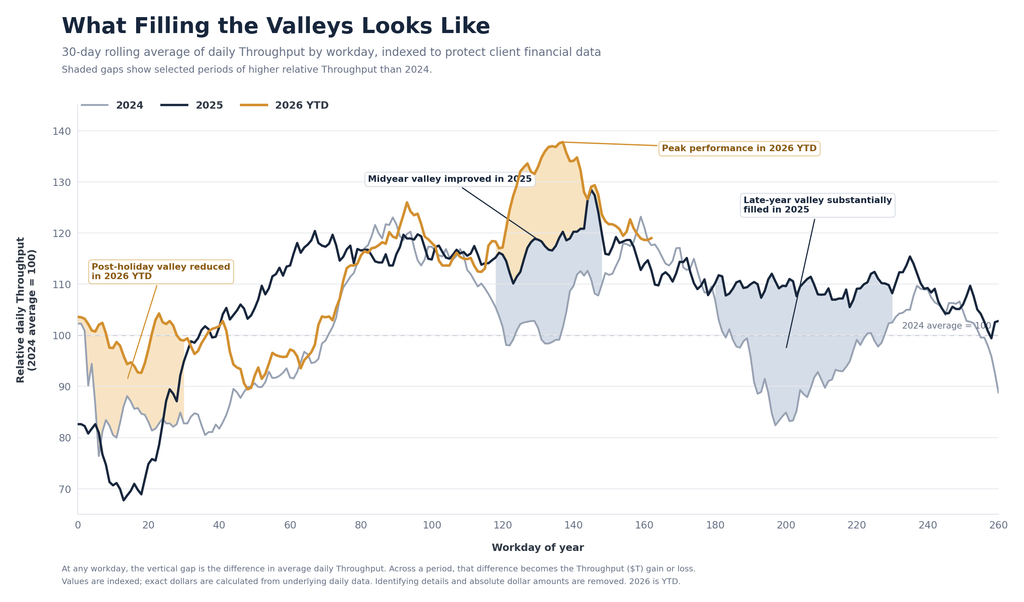
At any point, the vertical distance between the lines represents the difference in average daily Throughput. Accumulated across a stretch of workdays, that difference becomes the period’s Throughput ($T) gain or loss. Because this public graph uses indexed rolling averages, the exact dollar result is calculated from the underlying daily data rather than from the graphic.
The result is specific to this business, but the pattern matters. When a company controls its cost structure, continues applying the management system, and deliberately uses capacity that once sat underfilled, a predictable valley can become a significant financial opportunity.
Timing matters. If a particular market normally takes six or eight weeks to move from lead to installation, marketing cannot wait until the shop is already empty. The business must begin creating those opportunities while it is still climbing the peak.
This goes against what feels natural. When the shop is busy, the instinct is to ease off marketing and focus on getting the work out. When the shop slows, everyone suddenly wants more leads. By then, the front end is trying to solve today’s production shortage with work that may not arrive for another two months.
The answer is not to stuff the pipeline with any available work. The front end must generate enough of the right work, at the right time, to support the financial goal without overloading the constraint or sacrificing delivery performance.
Where Synchronous Flow Connects the System
Synchronous Solutions helps fabricators install this connection through the Synchronous Flow management system. We connect financial goals, market demand, conversion rates, lead times, and constraint capacity in one operating model.
That means establishing the daily Throughput requirement, translating it into market-level targets for confirmed orders, estimates, and leads, aligning marketing timing with the actual sales-to-installation cycle, and creating KPIs that provide early feedback.
Software can track the numbers. It cannot decide which numbers should govern the system or build the management discipline needed to act on them. That is the implementation work.
When the front end and back end are synchronized, the business can reduce violent swings between overload and idleness, gain more order and control, protect reliable delivery, serve customers better, and make stronger pricing decisions.
Cyclicality can be a trap, or it can become a predictable planning advantage.
It really sucks when the annual cycle runs your business. It is a very different business when you can see the cycle coming and take control of it.
Which business are you in?