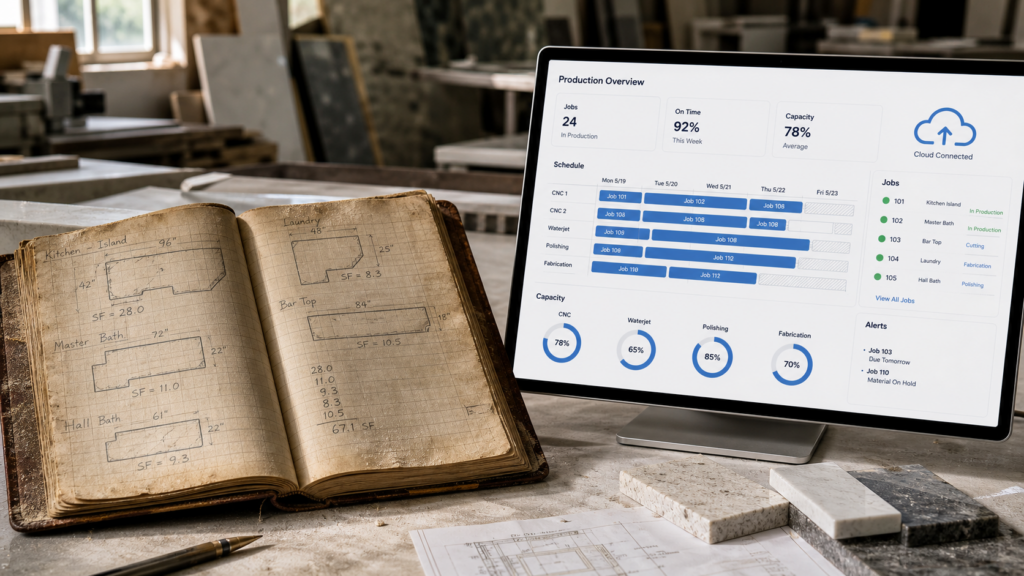
Short answer: Square feet is useful for estimating material, measuring physical volume, and communicating parts of a countertop job. It is a poor primary metric for production scheduling because it cannot see job complexity, promised dates, readiness, constrained capacity, or the financial result the business must produce.
A fabrication shop does not pay its bills with square feet. It pays them with the Throughput generated when finished work is sold, installed, invoiced, and collected.
Why can two equal-size jobs create unequal work?
Consider two kitchens that are each 40 square feet. One uses a simple eased edge. The other includes mitered build-ups, multiple sink cutouts, detailed seams, and more complex handling and installation.
The square-foot count is identical. The demand on programming, fabrication, finishing, quality control, staging, and installation is not.
A schedule built only around square feet can look level while loading very different amounts of work into the system. The result is familiar:
- A day that appeared reasonable becomes overloaded.
- Work orders compete for the same constrained resource.
- Jobs begin leap-frogging one another.
- The production planner changes priorities repeatedly.
- Overtime becomes the recovery plan.
- The business produces the planned square feet but misses its profit goal.
The problem is not that square feet is wrong. The problem is asking a dimensional measure to make an economic and capacity decision.
Why are sales dollars not enough?
Sales is closer to the financial goal, but sales dollars can also distort the picture. A job that uses expensive exotic material may have a high selling price without creating a proportionally high contribution to the business. Material price can increase sales even when it does not increase the useful output of the shop.
That is why Synchronous Flow begins with Throughput dollars, or T$:
T$ = Sales – Truly Variable Expenses
Truly variable expenses are the cash outflows that arise directly because the sale occurs, commonly direct materials, outside processing, direct freight, and sales commissions when applicable.
If a job sells for $4,500 and carries $1,500 of truly variable expense, it produces $3,000 of T$.
$4,500 – $1,500 = $3,000 T$
T$ shows the amount available from the sale to cover the company’s Operating Expense and, after OE is covered, create net profit.
Does higher T$ automatically mean a job is easier to schedule?
No. This is an important refinement to the original square-feet-versus-dollars argument.
T$ connects the schedule to the economic goal. It does not, by itself, describe every minute of labor or constrained capacity a job will consume. A high-T$ job can still be a poor fit for a particular day if it is not ready, cannot meet its promised date, or consumes too much of the capacity currently governing output.
A useful production schedule therefore combines:
- The daily T$ requirement.
- Job readiness and release rules.
- Promised installation or delivery dates.
- Available capacity by process.
- The current constraint.
- Product and feature mix.
- Expected job position within the production buffer.
More advanced tools can compare T$ with the time a job consumes at the constraint. Synchronous Solutions uses measures such as Octane and a Profitability Index when the team is ready for them. The first step is simpler: know the daily T$ target and build a capacity-based schedule capable of producing it.
How do you calculate the daily T$ target?
The company begins with the Operating Expense it must cover and the net profit it wants to produce:
(Operating Expense + Desired Net Profit) / Available Workdays = Daily T$ Target
Suppose the business expects $700,000 of Operating Expense for a 20-workday month and wants $100,000 of net profit. It must generate $800,000 of T$, or $40,000 per workday.
($700,000 OE + $100,000 desired NP) / 20 days = $40,000 daily T$
The production planner can now ask a better question than “How many square feet should we run?”
Which ready work-order mix can produce the required T$, respect available capacity, protect promised dates, and keep flow stable?
What should square feet still be used for?
Square feet remains useful. It may help with:
- Material estimates and slab yield.
- Physical handling and storage requirements.
- Initial workload comparisons within genuinely similar product families.
- Historical production context.
- Sales and market reporting where the limitations are understood.
The error is turning square feet into the goal of the whole operating system. A business can improve square feet per day while producing the wrong mix, increasing work in process, missing installations, or weakening profit.
How should a fabricator move from square feet to T$ scheduling?
1. Keep the square-foot data
Do not discard useful operational history. Use it as one descriptive measure, not the master scheduling objective.
2. Calculate T$ by work order
Use a consistent policy for sales and truly variable expenses so each job carries a comparable T$ value.
3. Establish the monthly and daily T$ requirement
Connect the schedule to OE, desired net profit, and the number of available workdays.
4. Make job readiness visible
A job should not enter production simply because it appears on a sales forecast. Confirm the information, material, approvals, programming, and site conditions required for reliable release.
5. Build the work-order mix around capacity
Level loading does not mean equal square feet. It means a deliberate mix the real process can handle while protecting the constraint and producing the required economic result.
6. Monitor each work order against expected position
Use buffer zones and On Track, Threat, and Hole status to identify risk early. Planners can then resequence, expedite, invest in overtime, or deploy another contingency before a late installation becomes unavoidable.
7. Learn from misses
Feed recurring threats, holes, callbacks, and constraint losses into the Synchronous Flow Improvement Team. The objective is to improve the system, not merely improve the team’s ability to fight fires.
What is the real goal?
The product may be measured in square feet. The business exists to produce a financial result for its owners while serving customers, creating meaningful work, and building an organization capable of continuing to improve.
The operating measures should connect to that goal.
To see the full method, read What Is Synchronous Flow? For a focused scheduling guide, read Throughput (T$) Scheduling: Set a Daily Profit Target and Reduce Production Chaos.
This article is based on a 2018 paper by Ed Hill, Founder and Ambassador of Synchronous Solutions. It was revised in 2026 to clarify the distinct roles of T$, capacity, readiness, and advanced constraint-use measures. The original paper remains available as a historical PDF.