THE FABRICATOR’S SIGNAL | ISSUE 10
Before you cut the hours, find out what those hours are protecting.
By Rick Phelps
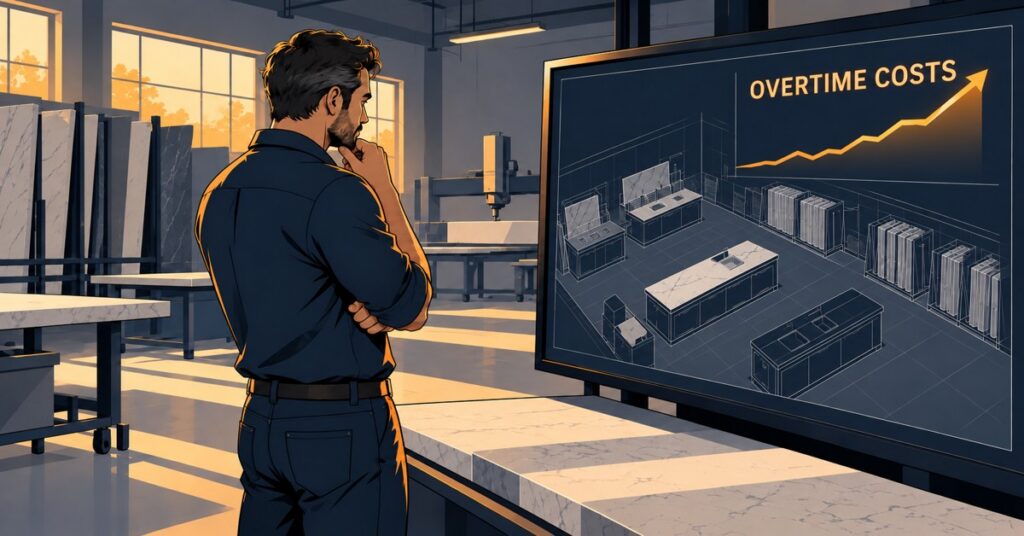
The owner was already worried about the year. Financial results were weak, overtime was up, and the install department accounted for much of the increase.
His financial advisor pointed to the year-over-year comparison and urged him to act. The owner told the operations manager to get install overtime under control. The manager said he would investigate.
A month later, the number had not moved. The owner went looking for the operations manager and found an install crew standing beside its truck. Frustrated, he unloaded on them.
From the owner's chair, the conclusion seemed obvious: overtime was the problem, management had failed to correct it, and the crew was wasting time while labor costs climbed.
Almost none of that was true.
The operations manager had investigated. The shop was operating with several fewer install crews than it had the year before while installing roughly the same volume. To keep up, the remaining crews were being scheduled for 12-to-14-hour days. The hours were not hidden or uncontrolled. They were how the business was covering a capacity gap and keeping customer commitments.
That does not automatically make the overtime good. It does mean the flagged line item was a signal, not a diagnosis.
Overtime tells you where to look
An overtime report tells you that labor is being used beyond standard hours. It does not tell you why.
Those hours might be covering absenteeism, rework, poor scheduling, avoidable waiting, or weak supervision. They might also be protecting revenue when customer demand exceeds the capacity available at a critical process. The financial statement records those situations the same way even though they require very different decisions.
If you treat every increase as a labor-discipline problem, you can make the spreadsheet look better while the business gets worse. Remove the hours without replacing the capacity and the work still has to go somewhere. It becomes backlog, delayed installations, broken promises, or pressure pushed into the next part of the system.
That is why the first question should not be, “Who allowed this overtime?” It should be, “What is this overtime protecting?”
Model the business before you cut the cost
A sound business model connects the work customers are buying to the resources and economics required to deliver it. It shows what must happen from the first sales conversation through templating, production, installation, and invoicing. It also shows where the current plan asks more of the system than the system can reliably provide.
Start with five questions:
Name the promise. What volume, mix, lead time, installation date, and service level has the company committed to deliver?
Map the required work. How much work must each process complete to keep that promise, including the normal variation the shop experiences?
Compare load with capacity. How much dependable capacity is available in sales, field measure, programming, production, installation, and billing? Where does required load exceed it?
Put economics around the gap. How many throughput dollars does the current sales volume generate? How much operating expense can the business carry and still earn its planned profit? At the current operating-expense level, how much profitable volume must the company actually complete?
Choose the lever that fits the cause. Recover lost capacity, reduce rework or variability, add the right resource, change the schedule, adjust price or mix, reset the service promise, or reduce cost where the system can absorb it.
This analysis may show that overtime is waste. If crews are waiting on missing information, returning for preventable callbacks, or absorbing a scheduling failure, fix the cause and take the hours out.
It may instead show that overtime is temporarily buying profitable capacity. In that case, cutting it without another plan sacrifices work the company has already sold or damages the promise made to customers. The right response could be to add capacity, change the promise, improve the mix, or reconsider whether the current volume is profitable enough to pursue.
The goal is not to defend overtime. The goal is to make a deliberate decision with the whole business in view.
A better management conversation
The owner in this case had a legitimate concern. The company was having a difficult financial year, and rising overtime cost deserved attention. His mistake was turning a signal into a verdict before understanding the operating conditions behind it.
That mistake had a human cost. The install crews carrying the extra load became the target of the owner’s frustration. The operations manager stopped at proving the hours were scheduled, without bringing the owner a decision about capacity and economics. The financial conversation stayed focused on a variance instead of the system producing it.
A better conversation would have brought those views together: finance identifies the change, operations explains what the hours are doing, and leadership decides whether the demand, capacity plan, and economics still make sense.
The next time overtime turns red on your report, resist the urge to manage the color. Ask what created the hours, which customer promise they are protecting, and whether the economics justify them. Then fix the cause.
With that clarity, the owner no longer has to choose between tolerating a rising cost and issuing a blind cut. He can see the tradeoff, make a bounded decision, and explain it to the people doing the work.
That is how overtime becomes useful information instead of a reason to blame the people keeping the business moving.