THE FABRICATOR’S SIGNAL | ISSUE 11
Waiting for sales to recover can leave you with fewer choices. Engineered Profit starts with what your business earns today and what it needs to keep.
By Rick Phelps | Synchronous Solutions
It has been a tough couple of years for the countertop fabrication industry. You can see it in the faces of owners at industry events, and in the absence of those who have cut back on travel to conserve cash.
If you are losing money, you probably do not need another reminder that the industry is hurting. You need to know how much longer the business can keep going this way, and what you can do about it.
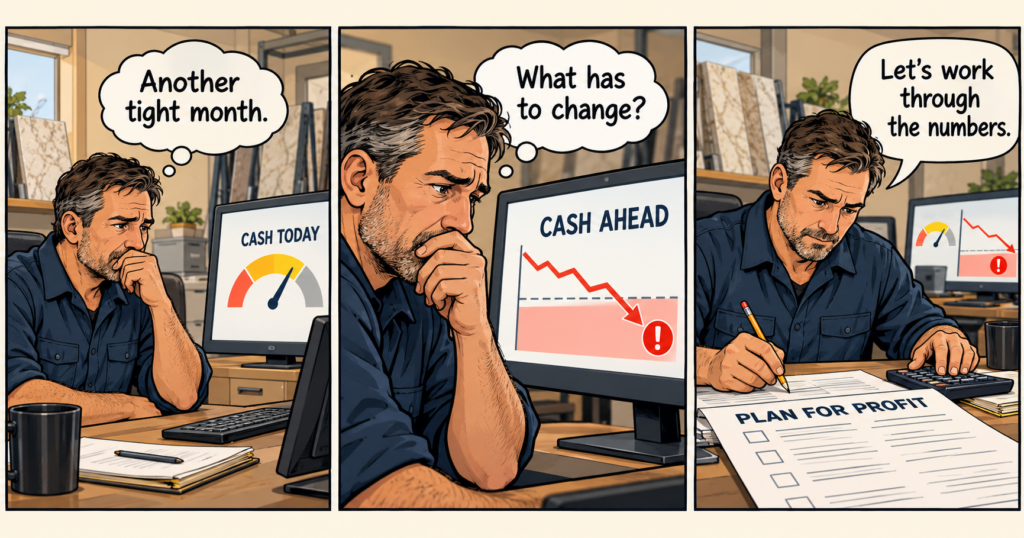
You built this business to create a better life for yourself and your family. You want to take care of your people and feel proud of what you have built. When each month ends with another loss, those ambitions can give way to one immediate concern: getting through the next month.
Just when things seem to be turning around, another uncertainty appears. You cannot control everything happening around your business. But you can confront what your business needs to change so it can support the life you want.
Jim Collins' discussion of the Stockdale Paradox in Good to Great is especially relevant: maintain faith that you will prevail while confronting the brutal facts of your current reality. Both parts matter. Faith without confronting reality becomes wishful thinking. Confronting reality without faith can leave you too discouraged to act.
We believe a major shake-out is happening in this industry. Some businesses will close. Others will emerge stronger. If your business is currently losing money, now is the time to pull your team together and determine what must change.
Decide what profit the business needs
For years, you have heard us recommend targeting Net Profit of 10% or more of sales. Not EBITDA. Net Profit, the bottom line of your P&L.
EBITDA has its uses, especially when someone is looking to buy your business. As an owner running an ongoing business, you also need to know what is left after all the expenses are accounted for. The business needs to earn a return for the work and risk you put into it.
It needs cash, too. Profit and cash are related, but they are not the same thing. You need to pay attention to both your bottom line and your bank account.
This brings me to my BFO of the decade, my Blinding Flash of the Obvious.
We, and probably you too, have been treating profit as whatever is left over.
In Throughput Accounting, we write:
Throughput − Operating Expense = Net Profit
Throughput is sales revenue minus the costs that vary directly with those sales, such as the material used for a job. Operating Expense covers the remaining expenses of running the business. To connect this calculation to the bottom line of your P&L, all those expenses must be accounted for.
The usual objective is to increase Throughput while holding Operating Expense steady. That makes sense. But it can also encourage us to focus on the Throughput we hope to generate while accepting the Operating Expense we already have.
Here is how I want you to look at it now:
Throughput − Required Net Profit = Allowable Operating Expense
The math has not changed. The order in which we make decisions must.
We call this Engineered Profit. You decide what profit the business needs, then determine what it can afford to spend at the Throughput it is actually generating.
If you are underwater, you may not be able to reach 10% immediately. But you need to begin closing the gap this month. Waiting for business to improve leaves both your profit and your choices dependent on something you cannot count on.
You are probably thinking I have lost all my marbles. Your business is losing money, and I am telling you to plan for profit? Bear with me. I believe I still have a marble or two left.
Put a number on the gap
Suppose a recent month, representative of the work your shop is doing now, shows $500,000 in sales and $325,000 in Throughput. For this example, let's set an initial Net Profit target of 5% of sales, or $25,000.
That leaves $300,000 for monthly Operating Expense.
If you are spending $350,000, you are losing $25,000 a month. To stop that loss and earn your targeted $25,000 profit, you need a $50,000 monthly improvement.
You can close that gap by increasing Throughput, reducing Operating Expense, or using a combination of both.
At your current Throughput percentage, generating another $50,000 in Throughput would require roughly $77,000 in additional monthly sales, assuming those sales do not require additional Operating Expense.
By all means, pursue those sales. But confront your brutal reality: how much additional business can you actually sell, produce, install, and collect payment for? And how soon?
Borrowing $25,000 could cover this month's loss. It would buy time, but it would leave the profit gap open and add debt. If nothing changes in the business, what will you do next month?
Make the decisions while you still have choices
This is why you have to look hard at Operating Expense now. Right sizing your business means eliminating expenses you can no longer justify and matching staffing to the work the business can actually support.
It requires judgment. You still need the people and capabilities to sell, produce, and install the work supporting your numbers. A cut that causes you to lose profitable sales or fail your customers can make the problem worse.
But if the numbers require a smaller team, you cannot keep postponing that decision.
Nothing is harder than letting members of the team you built go. These are people you know and care about. They have helped you build the business. Waiting can feel easier today, even as it puts the entire business at risk.
In our experience running and growing businesses and building teams, we have had to confront brutal facts and make painful decisions ourselves. We know how hard it is when the numbers call for changes that affect people you care about.
Facing those facts sooner gives you more room to act. You can make deliberate choices about what the business must protect and what it can afford, with a clearer view of what it will take to become profitable.
That is the purpose of Engineered Profit. You should be able to look at the work ahead and understand what it must contribute to the business you want to own. A business that earns a return, meets its commitments, and gives you room to plan beyond the next payroll.
If you need help understanding the gap, deciding what can change without damaging the business, or working through the difficult conversations, call us at Synchronous Solutions. We will help you turn the numbers into a plan you can put into practice.
Confront the brutal facts. Keep your faith. And act while you still have choices.