THE FABRICATOR’S SIGNAL | ISSUE 13
Your next manager should give you room to lead. Plan what that person will take off your desk and what the business must put behind the role.
By Rick Phelps, Synchronous Solutions
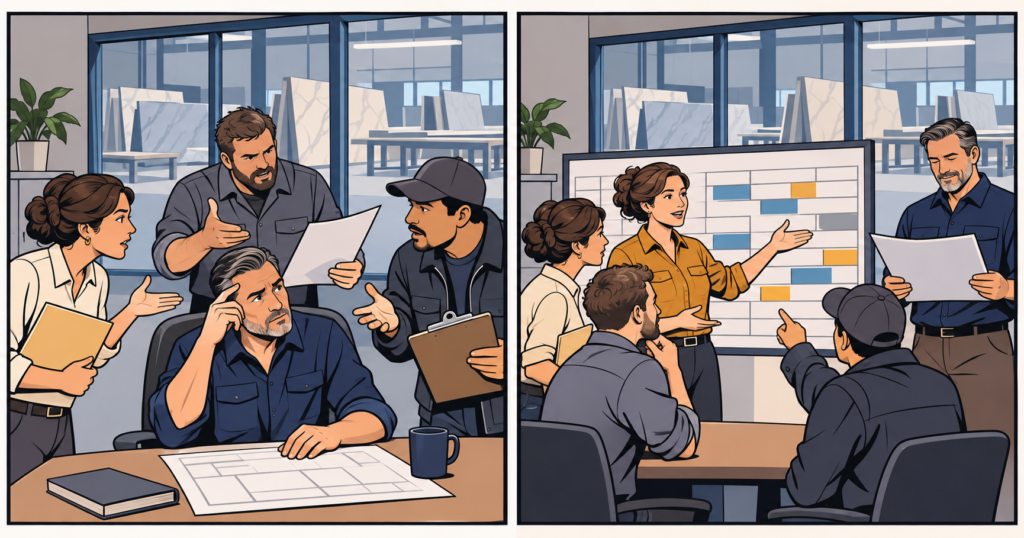
Picture a shop where sales has promised Friday, production says the tops will not be ready, and installation already has its crews committed. Each department has a case. As usual, the owner decides which promise moves and who calls the customer.
The job gets moving. A few days later, another job brings the same argument back to the same desk. The owner starts thinking about hiring a manager. Someone needs to take this over.
But what, exactly, will that person take over? If the departments still have conflicting priorities, nobody knows who can make the decision, and the schedule depends on what is in the owner's head, the new manager will need the owner's help too. Payroll goes up while the owner keeps doing the job.
Before choosing the person, decide what should stop needing you and what the manager must have in place to take responsibility for it.
Choose the responsibility you want to transfer
When every disagreement reaches the owner, people learn to bring their case instead of resolving the problem together. Sales defends the customer promise. Production defends the sequence. Installation defends the crews' commitments. Personalities begin to determine which priority wins because the business has not supplied a common basis for deciding.
The owner spends the day facilitating other people's work and the evening catching up on their own. Adding another name to the organization chart can leave that pattern intact.
The useful question is what should happen differently the next time those commitments collide. Who should decide? What should govern the decision? What information should the departments share before the customer needs an answer?
That gives the next management role a purpose you can recognize in an ordinary working week. The team resolves more of its own problems, customers get answers sooner, and the owner gains time to lead the business.
Give the manager time to manage
Your best fabricator or installer may look like the natural choice. They know the work, understand the shop, and have earned people's respect. Those qualities matter. The new role also requires a different kind of contribution.
There are three kinds of work to consider:
Doing the work. Templating, cutting, fabricating, installing, or quoting.
Running the system. Coordinating departments, resolving competing priorities, and keeping jobs moving toward the commitments the business has made.
Improving the system. Finding why the same problems return and helping the team make changes that last.
A manager needs ability and time for the second and third kinds of work. Occasional hands-on help can be sensible. If the old job consumes most of the new manager's day, the shop still lacks the management capacity the promotion was supposed to add. The owner keeps carrying it.
Plan for the training, authority, and coverage the change requires. Promoting a good person should give them a fair chance to succeed at the new job.
Give the team a way to decide
Return to the scheduling conflict. In the business you want to run, the departments work from the same commitments and can see whether a job is ready. They know who can change a priority and when an exception truly needs the owner. The manager can lead that discussion without reconstructing the plan from separate accounts of what happened.
That requires a shared view of job flow, clear decision authority, agreed rules for priorities and handoffs, and useful measures that reveal trouble early. Managers also need a regular opportunity to address problems across departments before they become customer emergencies.
These are things the business must put behind the role. A title cannot supply them. A capable manager can help develop them, but needs enough structure to take responsibility rather than spend each day asking the owner to interpret the business.
Headcount alone will not tell you when to make this change. The work, direct reports, shifts, locations, and experience of the team all matter. Watch how often routine decisions wait for you. That is a useful warning that the way the business is managed needs to change.
Plan for the cost before you commit
The management role needs a place in the financial plan too. Its expense can begin before better coordination produces stronger results. A shop that overlooks that gap can lose confidence in the hire just as the person is learning to lead.
Start with Throughput, or $T: sales revenue less the purchased costs that vary directly with those sales, such as material and sinks. This is the money available to pay labor and other operating expenses, with something left for profit.
If additional sales are how you intend to support the role, consider this illustration. A manager adds $100,000 a year in salary, taxes, and benefits. The shop retains two-thirds of sales as $T and targets net profit of 10 percent of sales.
Supporting that added expense while maintaining the target margin requires about $118,000 of additional annual $T, or $176,000 of additional sales. At $3,000 to $3,500 of $T per job, that is about 34 to 40 additional completed jobs a year, roughly three a month.
The example assumes the existing business already earns its target margin and can deliver the added work without other added costs. Additional labor, equipment, or replacement for a promoted employee belongs in the plan too.
More sales are one route. Better flow, recovered capacity, or a stronger price and job mix may also improve the economics. Be clear about where the contribution will come from. Then account for when the cost starts and how long the business may wait for the benefit. An annual earnings requirement does not tell you how much cash the transition will take.
Build the transition with the team
Before you choose a person, choose the recurring responsibility you are ready to transfer. What should no longer end at your desk, and what would the team need to handle it?
Synchronous Solutions can come on site to work through that with you and your team. We facilitate the decisions, teach the principles in the context of your operation, and help build the management responsibilities, operating support, and financial plan around the role. You have a guide and a team learning to carry the plan through, while the everyday work continues.
The next time Friday's promises collide, the owner should not have to settle the same argument again. Plan that change before the hire, and the next manager has a responsibility to own and a team better equipped to work together.